Black History Month, Celebrating Leaders Making a Difference!
South Florida faces many social, economic and political challenges. Yet we also have a growing roster of dedicated, caring leaders who have committed to making life here better for everyone.
During Black History Month, Be Strong International salutes the many Black professionals driving meaningful change at nonprofit organizations, charitable agencies and other improvement programs. Whether mentoring young people, advocating for equal access to resources or providing vital support to families in need, these nonprofit leaders embody resilience, vision, and commitment to positive change as they work tirelessly to uplift their communities.
“These dedicated professionals have been incredible role models for me and many others who want to serve those in need, not just economically but socially and emotionally too,” says Michelle Shirley, Be Strong International’s CEO and Chief Heart Officer. “From Althea McMillan, the beloved founder of our organization, to my fellow members of The Miami Foundation’s 2024 Saltwater Fellowship, these amazing individuals have inspired my career and been invaluable to me as mentors. I’m honored to have known and worked with many of them.”
Here are some of the men and women who have made a meaningful difference in our community and for our neighbors:
- Althea McMillan (1943-2024+)
Founder, Be Strong International
- Dr. Delvena Thomas
Corporate Psychiatrist at The GEO Group, Inc. and Medical Director at Be Strong International.
- Gale Nelson
CEO, Big Brothers Big Sisters of Miami
- Rodrick Miller
President and Chief Executive Officer, Miami-Dade Beacon Council
- Dexter A. Bridgeman
Founder/CEO, MIA Media Group
- Yolanda Cash Jackson, Esq.
Shareholder/Lobbyist, Becker and Poliakoff, P.A.
- Germaine Smith-Baugh
President/CEO, Urban League of Broward County
- Julie Robison
Founder, South Dade Women Veterans Alliance
- Amber Williams
Founder/Clinical Director, Upright Spine Center
- Michelle Johnson
Faith and Community Leadership Liaison, Miami-Dade County Mayor’s Office
- Shownda Pagan
CEO, Belafonte Tacolcy Center
- Stephanie Sylvestre
Co-founder, Avatar Buddy
- Trina Harris
CEO, Touching Miami with Love
- Nikisha Williams
Vice President of Collective Impact, The Mami Foundation
- Tiffany Wilson-Worsley
Director of Collective Impact, The Mami Foundation
- Toni Randolph
Philanthropist
- Symeria Hudson
President/CEO, United Way Miami
- 2024 Fellows, Saltwater Fellowship
The Saltwater Fellowship is a new initiative of the Miami Foundation that invests in leaders who can create data-driven solutions to the problems facing the community. The inaugural class of fellows focuses on the persistent racial inequality felt throughout South Florida.
- Kerry-Ann Royes, Class Chair and President/CEO, YWCA South Florida
- Tina Brown, CEO, Overtown Youth Center
- Esther Rose McCant, CEO, Metro Mommy Agency
- Derek Negron, Co-founder, The Light Preparatory Academy
- Marq Mitchell, Founder and Lead Steward, Chainless Change
- Darius Daughtry, CEO/Artistic Director, Art Prevails Project
- Fritzie Santoiry, CEO/Founder, Genesis Hopeful Haven
- Santra Denis, Executive Director, Miami Workers Center
- Tina Carroll-Scott, Medical Director, South Miami Children’s Center
- Zelalem Adefris, CEO, Catalyst Miami
- Michelle Shirley, CEO/Chief Heart Officer, Be Strong International

These accomplished professionals work year-round for the communities they serve, but Black History Month gives us a timely reason to thank them for all they do. Their greatest work may not be what they do today, but the achievements they will inspire by those who come after them.
At Be Strong International, we take great pride in recognizing the dedication and hard work of our team members. This year, we are honored to celebrate a significant milestone—five years of service—for several outstanding employees. Their unwavering commitment to our mission has played a vital role in strengthening families and communities.
Celebrating Five Years of Service
Reaching a five-year milestone is a testament to perseverance, passion, and dedication. We extend our deepest gratitude to Emmanuel Ovalle, Rodlin Gelin, Juan Camargo, Carlos Villacis, and Everson Joseph for reaching this incredible achievement. Each of them has consistently excelled in their roles, demonstrating outstanding leadership, professionalism, and a commitment to excellence. Whether managing projects, providing support to families, or contributing to our overall mission, their hard work and dedication have made a significant impact on our organization. They continue to inspire us all with their passion for making a difference, and we look forward to many more years of shared success.
A Heartfelt Thank You
As we celebrate these milestones, we extend our sincerest appreciation to all our team members who continue to embody the spirit of Be Strong International. Your dedication and service are the foundation of our success, and we are honored to have you as part of our team.
Congratulations to Emmanuel, Rodlin, Juan, Carlos, and Everson on their well-deserved recognition! We look forward to many more years of growth, impact, and shared success together.
[foogallery id=”307848″]
We’re thrilled to announce a significant and heartfelt milestone in our journey: “Be Strong Way” is now officially on the map! This incredible moment serves as a landmark not just in our community but in our organization’s mission to empower, educate, and uplift families and young people throughout Miami-Dade County.
On this special day, we were joined by Miami-Dade Mayor Daniella Levine Cava and Palmetto Bay Mayor Karyn Cunningham, who both delivered words of encouragement and support that truly resonated with all in attendance. It was also an honor to have our very own CEO and Chief Heart Officer, Michelle Shirley, lead the celebration with her inspiring vision and steadfast dedication. Each of these leaders, along with all who came out to support, helped make this event unforgettable and affirming.
The unveiling of “Be Strong Way” stands as a vibrant symbol of our commitment to strengthening families, building healthy relationships, and fostering resilience in our community. This street name is more than a marker on the map; it embodies the heart and soul of our work at Be Strong International. It’s a reminder that each day, with every workshop, conversation, and outreach event, we are collectively taking steps forward—empowering individuals and transforming lives.
Thank you to everyone who shared this moment with us, and to all our supporters who believe in our mission. Here’s to many more steps forward and continued impact as we keep walking down Be Strong Way, paving paths of empowerment and positive change!
Check more pictures here: https://www.bestrongintl.org/events/gallery/


In a recent interview with Authority Magazine, Mr. Darryl K. Auberry, a key leader and program manager of Parent Club at Be Strong International, shared valuable insights on nurturing resilience in children. Emphasizing the importance of building strong, supportive relationships, he discussed how crucial open communication and emotional guidance are in today’s world. Mr. Auberry highlights that fostering resilience goes beyond preparing kids to face challenges—it’s about instilling lifelong confidence that enables them to thrive and adapt.
From encouraging self-expression to teaching effective problem-solving skills, Mr. Auberry’s strategies remind us that resilience is a gift that parents, mentors, and educators can all help cultivate. For more on these practical approaches, explore his full interview and see how we at Be Strong are dedicated to empowering the next generation.
We’re grateful for our ongoing partnership with The Children’s Trust and Parent Club, who share our vision for empowering families and supporting youth resilience. Together, we continue to make strides in equipping the next generation with the skills and knowledge needed to succeed in today’s world.


Check more of the interview here:
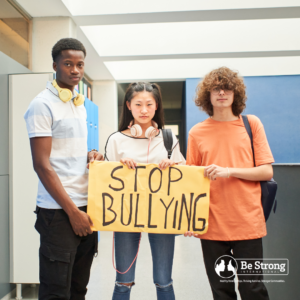
National Bullying Prevention Month
To call attention to this devastating issue and help families and communities find solutions, October has been declared National Bullying Prevention Month by PACER, an advocacy group for children with disabilities – a frequent target of bullies, who usually seek out the weak and powerless.
The need for such a campaign is painfully clear. According to the National Centers for Disease Control and Prevention (CDC), being bullied puts youth at higher risk for depression, anxiety, sleep difficulties, lower academic achievement, and dropping out of school, and can lead to physical injury, social and emotional distress, self-harm and even death.
Thankfully, bullying is no longer being shrugged off as a normal rite of childhood and no informed parent tells a child to “stand up for yourself” or “just ignore it and it will stop.” Efforts like PACER’s awareness month can help parents, educators and community members learn more about bullying so they can help prevent it. PACER calls the campaign “a nationwide call to action” that bullying can be prevented and stopped through education and awareness.
What Is Bullying?
The CDC defines bullying as repeated acts of “unwanted aggressive behavior” by one youth or youth group against another who is not their sibling or in a dating relationship with the victim. Power is the driving force behind the behavior: the stronger person attacking someone they perceive to be weaker. But physical, psychological, social, or educational harm.
Even the bullies can be harmed, says the CDC. They are at higher risk of substance misuse, academic problems and experiencing violence later in adolescence and adulthood. When they are also bullied themselves, they are at greater risk for mental health and behavioral problems.
Bullies work in several ways: physically, by using aggressive behavior like hitting, kicking and tripping; verbally, such as name-calling and teasing; socially, through harmful rumors and excluding from the group; and damaging the victim’s property.
An increasingly common form of bullying is cyberbullying, hurting the victim with technology like social media and texting. It’s an especially harmful form. Unlike other kinds of bullying, cyberbullying never stops; it follows the victim home and can be conducted virtually around the clock. It can also involve many more than one bully – groups can gang up on the victim. Even if the victim gets them to stop, the damaging rumors and false accusations remain in cyberspace forever.
Cyber activity is one of the specific acts cited in the anti-bullying policies of the school boards of both Broward and Miami-Dade counties, which added the policies several years ago in acknowledgement of the harm bullying can do to academic performance and students’ overall well-being. Both school boards’ definition of bullying includes teasing, social exclusion, threats, intimidation, stalking, physical violence, theft, public or private humiliation, destruction of property, and sexual, religious or racial/ethnic harassment.
Nationwide, bullying is on the increase – from 26 percent in 2019 to 40 percent in 2023 – according to the Boys & Girls Clubs of America’s annual Youth Right Now survey. The survey also reports that 18 percent said they experienced cyberbullying – up from 13 percent in 2019.
Hurting Academic Performance
Students who suffer from bullying also find their schoolwork suffering. According to a study cited by the American Psychological Association, children who suffered chronic levels of bullying during their school years had lower academic achievement, a greater dislike of school and less confidence in their academic abilities. The performance was about the same for children who had experienced moderate bullying that increased later in their school years.
The good news is that children who suffered decreasing bullying showed about the same performance as children who had never been bullied – so it may be possible to recover from bullying after it stops.
That makes it even more important to focus on prevention of bullying.
Top 5 Ways to Protect Yourself
The website StopBullying.org offers these and other strategies to deal with bullying, including cyberbullying:
- Seek assistance from an adult, friend, or classmate when a potentially threatening situation occurs.
- Avoid unsafe places; walk with friends or a small group of friendly peers.
- Never accept friend or network requests from unfamiliar people.\Follow the “forever” principle: Assume that everything you put online will be there forever.
- Block threatening or questionable people from seeing your profile and personal information.
- Regularly change passwords to sites and applications, and immediately delete profiles that have been hacked.
Get Involved and Take Action
Everyone suffers from bullying, not just the bully’s targets. When one person is diminished and discouraged from becoming all they can be, the entire community loses the contributions they might have made. The CDC advises communities to work together by creating a supportive space for all, with strategies like early childhood home visitation, parenting classes and family relationship programs. The agency recommends strengthening youth skills with universal school-based programs and building programs that connect youth to caring adults.
Be Strong International has been taking this approach since we were first founded to strengthen family relationships and provide children, youth and teens with the tools they need to succeed mentally and emotionally. From Project H.O.P.E. to the Be Strong After School Club and GEMS (Girls Empowerment Mastery Sessions), many of our programs are specifically dedicated to helping teens and young adults make informed decisions about healthy relationships and character development, while the Raising the B.A.R. Parent Alliance helps parents raise happy, healthy, successful children. We infuse all programs with Heart SkillsTM, our unique guidance that brings the mind, will and emotions into harmony for greater self-reflection and purposeful alignment with anyone we seek to meaningfully connect with. By guiding our young people to reach out in a conscious effort to understand each other, we can help them build the self-esteem and confidence they need to seek help against bullying behavior and overcome it.
To learn more about bullying and get involved in the fight to prevent it – or to report instances that affect your child or others – see the Resources section of this article.
Facts About Bullying
According to PACER’s National Bullying Prevention Center and the National Center for Education Statistics:
- One of every five students report being bullied – made fun of, physically attacked or excluded from activities on purpose.
- Most say they were targeted for their physical appearance, race/ethnicity, gender, disability, religion or sexual orientation.
- Almost half of youth ages 9-12 say they have experienced bullying at school and 14.5 percent say they have experienced bullying online.
- Of students ages 12-18 who report being bullied, 15 say they were bullied online or by text.
- Cyberbullying varies by gender. Girls are more likely to be the subject of hurtful rumors while boys more often get threats of physical harm.
- School-based bullying prevention programs decrease bullying by up to 25 percent.
Resources
- CDC Fast Fact: Prevent Bullying – Defining the problem and specific action everyone can take to prevent it.
https://www.cdc.gov/violenceprevention/youthviolence/bullyingresearch/fastfact.html
- PACER: National Bullying Prevention Month – Information and tools for raising awareness of the problem and taking action against it.
https://www.pacer.org/bullying
- PACER: Sites for Kids and Teens – How children and teens can identify and deal with the problem, including a checklist to determine if you’ve been engaging in bullying behavior.
https://www.pacer.org/bullying/info/sites-for-kids-and-teens.asp
- Stop Bullying – How to recognize bullying behavior and what you and your child can do when experiencing it.
In English https://www.stopbullying.gov and Spanish https://espanol.stopbullying.gov.
- STOMP Out Bullying™ HelpChat Crisis Line – A free, confidential online chat that helps youth ages 13-24 with issues around bullying, cyberbullying and suicidal thoughts. ; as well as providing support to youths who may be at risk of suicide.
https://www.stompoutbullying.org/helpchat
###
Sources:
PACER: https://www.pacer.org/bullying/info/stats.asp
CDC: https://www.cdc.gov/violenceprevention/youthviolence/bullyingresearch/fastfact.html
American Psychological Association: https://www.apa.org/news/press/releases/2017/01/school-bullying
Checklist by Michelle Shirley – A new school year starts soon in South Florida, and if your family is like mine, you’re rushing from store to website and back again, armed with lists of supplies and clothing your child will need to be physically and intellectually ready to learn on that first day.
There’s one more back-to-school list to check off so you can answer a critical question: Is your child socially and emotionally ready?
Social and emotional readiness has always been important for setting children up for success. But today, in the aftermath of the COVID-19 pandemic’s school closures, it’s more important than ever for parents to ask themselves the question.
A child or adolescent who is ready for the social and emotional demands of school will enter the classroom with confidence (although a few butterflies are perfectly normal). They are willing and able to listen to their teacher and participate in a positive, non-disruptive way. They’ll have good social skills to get along with classmates, make friends and express their emotions appropriately.
Two years after Florida schools reopened to full in-person learning, many children still are coping with the effects of the pandemic, which cut them off from the critical social support of friends, teachers and coaches. Many students fell behind academically as they — and their parents and teachers — struggled to quickly figure out how to use remote-learning technology.
The National Institutes of Health has identified numerous mental health problems related to COVID in youth, including anxiety, stress, depression, panic, irritation, impulsivity, sleep problems, post-traumatic stress disorder and even suicidal behavior.
The Florida Association of Children’s Hospitals reports, “What began as a public health emergency turned into a mental-health crisis. The duration of the pandemic, isolation from friends and family, effects of parental stress and economic hardship and loss of loved ones take their toll on children’s mental health.”
U.S. Surgeon General Vivek H. Murthy issued a similar warning in December 2021: “The pandemic era’s unfathomable number of deaths, pervasive sense of fear, economic instability and forced physical distancing from loved ones, friends and communities have exacerbated the unprecedented stresses young people already faced.”
It’s normal to regret leaving behind the glory days of summer vacation to return to school, but not so that it interferes with performing in school or connecting with peers. Don’t hesitate to seek professional help if you sense your child is experiencing anxiety, depression or another serious mental-health condition that keeps them from enjoying school. You can also help them adjust to a new school year with some positive approaches:
▪ Help them build a positive mindset.
In the weeks before school starts, look for opportunities to talk about the positive things that school brings: new experiences, new friends, new things to learn. Be careful not to overwhelm them, especially if they tend to worry about the future.
Now is also the time to set a routine for sleep, meals and work. Don’t suddenly spring an early bedtime on children the night before school starts.
▪ Play “What if?”
Ask them to imagine some scenarios they’re afraid of; strategize handling them successfully. What if the teacher asks me a question, and I don’t know the answer? What if someone picks on me? What if I lose my lunch money? End the game by helping them visualize a positive experience. What if everyone loves me and I have a terrific first day?
▪ Be there after their first day.
Do your best to be available when they get home, or soon after, on their first day. If you can’t be there in person, plan to call or text them. Ask how their day went, but don’t push for an answer. Expect them to say it was “fine,” go off on their own and come to you a few hours later to tell you everything.
▪ Help them connect with others.
Encourage your child to join after-school clubs, sports or community organizations where they can develop the social skills they missed if they were learning from home during the pandemic. Children learn their most important social skills by watching and interacting with their peers, and the more contact they have in fun, relaxed settings, the more successful they’ll be in class.

Michelle Shirley is CEO and Chief Heart Officer ® of Be Strong International, a Miami-based non-profit organization, which provides South Florida youth and families, healthy-relationship education.
Thank you to the Miami Herald for publishing this incredibly valuable Op-Ed.
Read more at: https://www.miamiherald.com/opinion/op-ed/article277907503.html#storylink=cpy
One of the most essential components of a successful and happy marriage is intimacy. Emotional intimacy is no exception. Is it a problem if you’re not as intimate as you once were? Marriages with insufficient emotional intimacy are more common than you would assume. Couples who are experiencing this circumstance are interested in understanding if the relationship can endure this condition or not, despite the fact that the reasons for this vary. To understand emotional intimacy in marriage, you will need to ask yourself these questions:
- Are you two growing distant from one another?
- Is it difficult for you to communicate with your spouse?
- Do you ever feel that “my partner doesn’t get me” or like two ships that greet each other with a light at night?
If your response to the questions above is yes, you might need assistance. Relationships suffer when there is emotional distance. A strong relationship is built on emotional connection in marriage. You can develop emotional closeness with your spouse.
Read more about the importance of emotional closeness in a healthy marriage in this article along with suggestions on dealing with it.
Understanding emotional intimacy
Emotional intimacy occurs when you strongly connect with your partner and share your vulnerabilities. One of the most fulfilling components of a relationship for many couples is being able to share their most private thoughts and feelings with their partner.
Intimacy on an emotional level promotes security and trust in your relationship. Emotional intimacy is feeling close to, emotionally attached to, and supported by your spouse. You may let down your guard in an emotionally intimate marriage, allowing yourself to be vulnerable and express your concerns, hopes, and dreams with your partner. You can be wholly yourself when both you and your spouse have emotional intimacy.
You’re more prone to experience feelings of loneliness or resentment in a relationship marked by emotional distance. It’s less probable that you’ll experience love, respect, security, or support.
Emotional and sexual intimacy are not the same. Regardless of how enjoyable your sexual experiences are, a relationship will suffer if there is a lack of emotional connection. The best part is that a couple’s sex life usually gets better as they develop emotional intimacy.
Sexual closeness and emotional intimacy are not quite the same. But, it might improve the sex.
We require emotional closeness. We are wired for connection as humans. By releasing the feel-good chemicals oxytocin, endorphins, dopamine, and serotonin, emotional connection uplifts our spirits. Even life expectancy can be increased by intimacy.
The importance of emotional intimacy
Lack of intimacy tends to increase if we do not foster it. Sometimes, couples may not have developed emotional intimacy from the beginning of their relationship. This could be due to various reasons such as individual differences, past experiences, or external factors that may have hindered their ability to connect on a deeper level. In such cases, it’s important to actively work towards developing emotional intimacy by communicating openly, expressing vulnerability, and actively listening to each other.
In other cases, emotional intimacy may deteriorate over time, especially as the initial excitement of the relationship fades away. Partners may begin to take each other for granted or become complacent, leading to a lack of effort in maintaining emotional closeness. The reason couples always give is:
“I love my spouse, and I know that he loves me, but I need to experience his proximity more frequently, and I am unsure how to make that happen.”
In such situations, it’s important to recognize the issue and take action to reignite the spark by spending quality time together, expressing appreciation, and engaging in meaningful conversations.
Why the need for emotional intimacy?
Emotional intimacy is an integral part of a healthy marriage. It is a deep connection that allows partners to share their feelings, thoughts, and experiences with each other. When couples build emotional intimacy is a crucial aspect of a healthy marriage. When partners connect on an emotional level, they create a space where they can be vulnerable, understood, and supported. This bond can strengthen the marriage and help partners navigate the ups and downs of life together. Below, we’ll discuss some of the important reasons why emotional intimacy is necessary for a healthy marriage.
-
Better Handling of Difficulties
Regardless of your differences, you can overcome obstacles by bonding on an emotional level. Relationship difficulties are unavoidable, so it is essential to learn how to deal with them. When spouses can’t handle obstacles, most partners decide to part ways. The ability to count on your lover for emotional support is made possible by an emotional connection, which is crucial when trying to solve problems.
-
Setting Reasonable Goals
The majority of partners have inflated hopes. They are dissatisfied when they discover that their hopes aren’t fulfilled at the end of the day. Establishing emotional connection enables you to set reasonable expectations. It gives you and your spouse the room to respect and encourage each other despite your differences and physical limits. You will be in a position to make better accommodations for what the other partner isn’t providing for you. This fosters a sense of inventiveness, tolerance, and trust. In the end, you both benefit from a fulfilling relationship where you both know what to anticipate from your spouse.
-
Elevated Respect Between Partners
In partnerships, emotional closeness makes it easier to express and receive respect from your partner. When there is a disagreement, respect is useful. When there is no respect, there is a vicious exchange of angry words, and no one is willing to admit when they are wrong. Respect enables you to take into account the other partner’s feelings and assist in amicably resolving the disagreement. An emotional connection fosters respect, which is essential for settling disputes between couples.
-
Allows for Impromptu Fun
The worst kind of fun a partnership can have is forced enjoyment. Fun gets dull and lackluster when it is planned. Relationships that are emotionally intimate provide you two the freedom to act impulsively and have fun. You may connect more easily when you have emotional ties. You won’t have to work hard to have fun and really appreciate each other’s company. You can both relax and have fun whenever you choose.
-
Genuine Communication
You may listen intently for genuine comprehension when you have emotional connection. You’ll be able to pay attention to your companion and comprehend their perspective. This gives you a platform to interact more effectively and pay attention to one another. One of the main factors that contribute to marriages disintegrating so rapidly and readily is a breakdown in communication. Understanding when and how to listen and when you should speak will help you communicate with your partner more effectively. Genuine, sincere conversation can flourish on an intimate foundation.
-
Makes Your Relationship More Genuine and Authentic
You don’t hold anything back from your spouse when you feel an emotional connection with them. Instead, your interaction will be genuine and grounded in reality. At all times, your relationship will be built on genuine emotions rather than façade.
-
Improves Physical Health
One of the causes of bad health in humans is stress. Your body releases the mood-enhancing hormone oxytocin when you are content in your relationship. A content life encourages connection and strengthens your partnership. This promotes health at its best. Relationships with emotional connection avoid suspicion, envy, and the need for retribution. You’ll benefit from balanced energy, resilience, a healthy libido, and regular sleep cycles. Improved sleep encourages good health.
Constantly make an effort to emotionally connect with your partner. Physical intimacy is crucial, but when coupled with emotional closeness, a relationship is more likely to last longer, be happier, and be healthier.
Marriage Matters
In conclusion, emotional intimacy is a vital aspect of a healthy marriage. It allows partners to connect on a deeper level, fostering trust, empathy, and understanding. When couples cultivate emotional intimacy, they create a strong foundation for their relationship that can weather any storm. While building emotional intimacy may take time and effort, the rewards are worth it, as it can lead to a more fulfilling and satisfying marriage.
If you want to learn more about building emotional intimacy in your marriage, check out Be Strong International’s Marriage Matters program. This program is designed to help couples develop the heart skills and the tools necessary to build and maintain a strong, healthy, and emotionally intimate marriage. With the guidance of experienced coaches, workshops, and events, you and your spouse can learn how to deepen your connection and create a loving and supportive partnership that will last a lifetime.
Visit our website at www.bestrongintl.org/marriage-matters/ or contact us here.
Women’s History Month, a time to encourage and support one another.
Women’s History Month is a time to celebrate and recognize the achievements of women throughout history, as well as to inspire and encourage women to pursue their dreams and ambitions. This month serves as a reminder that we all play a role in creating a more equitable and inclusive world where women have equal opportunities and are free to live their lives to the fullest. It’s a time to support and uplift the women in our lives, and to commit to working towards gender equality every day.
The Women Behind Be Strong International
Mrs. Althea McMillan, Founder.
Be Strong International was founded by a resilient, smart and kind woman, Mrs. Althea McMillan, a retired Miami-Dade Public School’s teacher. Driven by her own story, being herself a former 15-year-old pregnant school drop out, she became committed to educating youth and parents on fostering and maintaining themselves emotionally, mentally, physically and spiritually. In 1992, she founded Be Strong International and grew the organization almost single-handedly until the community started to take notice of its impact. Her goal was to end the cycle of broken individuals and family relationships.
Michelle Shirley, CEO & Chief Heart Officer.
Michelle began her career at Be Strong International in 2005, and advanced professionally from office and program manager to CEO. Since taking on the role in 2012, Michelle has increased the organization’s annual operating budget from $250k to more than $3 million and increased its programmatic impact to serve more than 8,000 youth and families each year in Miami-Dade and Broward Counties. Under her leadership, the organization offers an array of resources that teach Heart SkillsTM , essential skills that help transition individuals from brokenness to wholeness. Affectionately known as the Chief Heart Officer, she is a frontline leader in the community. Her vision for the organization has brought about a unique approach to social programs that touch people in every stage of their lives, especially the youth.
Be Strong International empowers women not only in the workplace, but in the community as well. Women are mothers, wives, daughters, sisters, professionals, and this celebration is all about women coming together, sharing resources, connecting, and encouraging one another.
Let’s celebrate Women’s History Month by amplifying women’s voices, support one another to continue breaking the glass ceiling, continue doing amazing things in the community, and continue thriving in our personal lives while creating a better future for all.
Watch below the inspiring messages from some of the amazing women at Be Strong International as we celebrate the strong and powerful women we are surrounded by!
Teen Dating Violence Awareness Month is observed every February to raise awareness about the prevalence of violence in teen relationships and to encourage communities to take action to prevent it. It is a crucial time to educate young people about healthy relationships and empower them to recognize and seek help in cases of abuse.
Recent Statistics on Teen Dating Violence
While in-roads have been achieved, the prevalence of teen dating violence locally remains an important public health issue. As listed the 2019 Centers for Disease Control (CDC) Youth Risk Behavior Survey for high school respondents, 11.6% of Miami-Dade County’s youth have experienced sexual violence, including kissing, touching or being physically forced to have sexual intercourse when they did not want to one or more times during the 12 months before the survey, compared to 10.8% in the State of Florida. Another result from the same study shows that 8.3% dated or went out with someone during the 12 months before the survey and experienced physical dating violence one or more times during the 12 months before the survey, with dating violence defined as being physically hurt on purpose (including being hit, slammed into something, or injured with an object or weapon).
Of Florida’s 67 counties, Miami-Dade County ranks second reporting 8,160 domestic violence offenses in 2019 resulting in 4,188 arrests. Home to over 2.7 million people, Miami-Dade is Florida’s most ethnically and racially diverse county (65% Hispanic or Latino, 17.1% Black and 15.45 White non-Hispanic). With a population of 52.4% foreign born, ancestry groups include Cubans, South Americans, Caribbean Islanders, and Europeans.
While the overall poverty rate is 15.7%, Miami’s income inequality, the second highest in the nation, is reflected through poverty levels exceeding 30% among marginalized groups, especially amongst Miami-Dade’s immigrant populations. Studies have shown that adolescents from minority groups, single-parent households, and homes in which parents have lower levels of education report more physical teen dating violence that is either moderate to severe. Over 55% of Miami-Dade’s households are single parent as compared to 38.3% in the U.S. and 46.8% in Florida. Additionally, a mere 30.7% of the population has a Bachelor’s degree or higher. Furthermore, Miami-Dade’s ethnically and racially diverse population is a contributing factor to its domestic violence arrest rate increase of 5% from 2018 to 2019.
Effects of the COVID-19 Pandemic on domestic violence.
Juxtaposed to this 2019 increase in perpetrator accountability, an October 2020 news report highlights the impact of the COVID-19 pandemic on domestic violence cases filed in local civil court, dropping by more than half. For Judge Carroll Kelly, Eleventh Judicial Circuit of Florida Domestic Violence Division, the concern is real, stating that domestic violence is “probably increasing due to all the factors that contribute to [it]. People being home, people losing their jobs, drugs and alcohol, children around constantly, no relief, no help.” The Domestic Violence Division is placing special emphasis on partnering with local organizations to provide additional outreach, advocacy, and support.
Efforts to mitigate teen dating violence and encourage healthy relationships among youth.
Be Strong International, Inc. (BSI) is at the forefront in Miami-Dade County in advocating for healthy relationships among middle and high school youth ages 11 to 19. Primarily serving the Miami-Dade County Public School (M-DCPS) system, the fourth largest school district in the nation, BSI envisions an environment where children progress through their adolescent years marked by healthy relationships that support their social-emotional growth. For over 30 years, the organization has cultivated a dialogue supporting healthy relationship building skills amongst Miami-Dade County’s diverse racial and ethnic populations, possessing the experience and earning the respect of multiple governmental entities and officials and institutions that support education of youth and well-being of the family.
For more information about our youth programs, visit our Programs page and explore all the programs offered in our Youth Division. For donations and support to continue these programs, please click here.
Other resources:
— Tea Consent video: (10) Tea Consent – YouTube A great metaphor and easily teachable lesson to audience of all ages.
— A domestic violence center based in Pennsylvania created this bank of healthy dating resources geared towards young people, including topics like red flags in relationships, the spectrum of healthy to unhealthy relationships, technology and dating, and more. There are also quizzes and games for users to complete that pair with the subject matter.
— We Think Twice, a campaign made by teens for teens, has assembled resources on dating and relationships, importantly including friendship relationships in the discussion. The site includes lists, videos, quizzes, checklists, and even content for trusted adults.
— The CDC has developed a dating violence prevention model called Dating Matters that promotes healthy relationship skills and dating risk reduction.
— The University of Colorado wrote a list of three dating “hacks”, essentially healthy rules of thumb for young people to explore when considering relationships. It is followed by a list of relevant resources to this topic.
The rising influence of societal issues has negatively affected parenting. Many parents are perplexed about raising their children morally upright without worrying about peer pressure and negative character. There’s a need to nurture a child’s physical, social, moral, and emotional development. One of the advisable ways to do this is by improving the parent-child relationship. Good relationships can help improve your children’s future and reduce home stress. The quality of child and parent relationships is important to children’s development.
How parents relate to their children can profoundly affect how children develop social and emotional competencies, gain self-control, and learn to solve problems, interact with others, and become responsible adults. Remember the saying, “Charity begins at home”? Yes, it begins at home—how you raise and interact with your kid has a ripple effect on their relationship with others in school, society, and family, and it all starts with you.
We all want the best for our kids, but it can be challenging to remember when facing a vocal teenager or an immature tween. Do you want to improve your relationship with your children? Here are six proven ways how to do it:
1. Gain Their Trust.
Kids are comfortable around people who make them feel easy. One of the best ways to build or improve a healthy relationship with your child is to gain their trust. What does this mean? It requires a two-pronged effort. It means you have to prove to them you are on their side while trying to keep your interactions with them as positive as you can. The side-effect of this is a friendly bond. Your child shouldn’t perceive you as a villain or enemy to conquer. They need to trust and depend on you.
Children need parents. If your main goal is to be their friend and not their parent, they might not listen to you when you try to influence them. Friends tend to always say yes to us. but sometimes parents need to say “no.” As much as you can, try to remain kind to your children, they’ll get close and find you easy to talk to. Kids need someone who will listen to them, encourage them and be there for them when things go wrong. If you don’t gain their trust, it’s going to be difficult for them to heed your advice when you give it to them.
Gain your children’s trust and you will see your relationship with them improve.
2. Show them affection and love.
One of the most important things parents can do is show affection toward their children. This doesn’t mean hugging them when they’ve just spilled juice on the couch (although that would be nice), but it does mean letting them know they’re important to you by being patient when they’re having a hard time learning or by giving them extra attention when they’ve done something special or complex. Your child needs to feel loved, but it can be challenging to express your love for your child. The best thing you can do is to show affection in many different ways. Hug, kiss, and tell your child you love them daily. Children need to hear this message repeatedly to know you love them.
Young children need physical contact with their parents. They need hugs and kisses and cuddles. They need to hear and know they are loved and valued by their parents, who are the most important people in their lives. Showing love in words and actions builds children’s trust. If you don’t show affection this way, your child will feel unloved or unwanted. This can lead to problems with self-esteem, anxiety, and depression later in life.
3. Be supportive.
Your actions or inactions are a huge deal to your child. Children love to be seen, supported, and celebrated. Say, your child has a competition at school; your presence will mean a lot more than a gift or apology. Be available when they need you and be ready to support their aspiration, fun, academics, extracurricular activities, etc. When praising your child, use descriptive praise. This type of praise includes the reason you are praising them in the actual praise. For example, if you want to let them know you are proud of them because they got a high grade on a test you could say “I’m proud of you for earning an A+ on the test!” instead of “good job!” This way your child will hear what they did to earn them praise. This will increase the probability they will repeat their behavior in the future.
Praising your children also helps build positive relationships because it shows you’re proud of them.
4. Listen actively.
Your children have a lot to say, and they need an adult who will listen to them. They might want advice or someone to hear them out without judgment or interruption. If your child comes to you with a problem, let them know you’re willing and available to hear them.
Don’t dismiss what they are saying; listen and let them know what they have to say is important to you. When kids feel heard and understood, it makes it easier for them to open up about other things in the future when they need help or advice. A child who finds you trustworthy will tell you all details of their day in school, interaction with friends and other concerns.
When was the last time you sat with your child to catch up on their week? You can do this over lunch or dinner or during a family hangout. Better still, talk to your child privately. Please don’t assume that living together means seeing or hearing everything, and it doesn’t also translate to quality time. Dedicate ample time to converse, play games and have fun with your kids. Understand that, as they grow, having certain discussions such as puberty, sex and relationship may become difficult. Still, you must find your way around it and make it easy for them to speak by gaining their trust and listening attentively.
Healthy relationships can occur if you listen and take action. If you consistently interject your conversation with your child without understanding, they will not tell you important things. Learn to listen to their side of the story. Yes, kids have emotions, and they can display them.
5. Be a good role model.
Children learn by watching what adults do. If you expect them to do something because they know it’s the right thing. So make sure you’re doing the right thing yourself, and they’ll follow suit. They learn from what you say and do. In fact, they know more from the things you do in their presence. Improving your relationship with your kids requires intentionality. Parents can set a good example by having strong relationships with their parents and siblings. Children learn how to treat others by watching how their parents treat others, including family members and strangers.
Children also learn from what they see parents do daily. If a parent works hard at their job, the child will likely follow suit when it comes time for them to enter the workforce. If the parent takes care of their appearance daily, the child will do likewise.
Children with good relationships with their parents also tend to have better relationships with others. Children learn to interact positively with others through interactions with their parents over time.
Parents should also try discussing issues that may be causing a rift in their relationship with their children so they can come up with solutions together before things get too bad between them. Parents should also be aware of their behavior and strive to ensure it’s consistent with their values. For example, a parent who often yells at people or uses negative words will indirectly make the child think it’s normal behavior.
6. Exercise patience with them.
Kids are special and should be treated as such. Relating with them shouldn’t be forced- an uneasy relationship demoralizes them. Children need boundaries and rules to feel secure and successful in life. While this is true for all children, it is vital for those with special needs or disabilities to require extra support from their parents or caregivers.
If you want your child to behave well and do what is right, make sure they understand what you require of them at all times. Give them enough time to learn to comply with these expectations without being punished when they don’t follow them immediately (or at all).
CONCLUSION
No one gets a perfect hang of parenting; you learn every day. We have shared some healthy relationship tips to maintain and improve parent-child relationships. Aside from general parenting advice, the best way to enhance parent-child relationships is communication. Communicating with your child not only allows you to teach your child how to interact with others and handle themselves in different situations properly, but it also gives you a chance to learn more about your child’s hopes, aspirations, and worries.
Ultimately, you must understand your child and not compare them with their siblings or other children. Pay attention and truly listen to your children; you will see what methods work best for improving your parent-child relationships with them.
Meet other parents right here in Miami-Dade at Be Strong International’s Ready to Talk, a free parent communication workshop to improve interaction, learn heart skills, gain your children’s trust and build a healthy and long-lasting relationship with them. The workshop will help you overcome communication barriers, build healthy relationship skills, and provide practical sessions for raising good and competent kids and teens.
The workshops are designed to help you raise kids and teens without hassle and guilt while following practical ways and learning from other parents who share great values.
Parents participating in the Ready to Talk parenting workshop will have the opportunity to learn new tactics and heart skills they can apply to raising their children. We give adults the tools and resources to address healthy relationships amongst parents and children while maintaining a non-threatening and supportive environment. These workshops are offered in English, Spanish and Creole.
Join any of the upcoming workshops in Miami-Dade at bestrongintl.org/upcomingevents.
If you have any questions, you may contact our Parent Facilitators here.